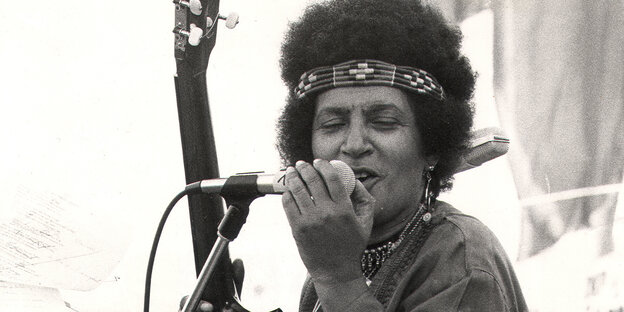
“Ich bin am Leben geblieben, aber die jüdischen Frauen, mit denen ich zusammen war, sind alle vernichtet worden. Das ist der Grund, warum ich politische Lieder singe.”
I stayed alive, but the Jewish women I was with, all have been destroyed. That’s why I sing political songs.”
Fasia Jansen
Fasia Jansen was born in Hamburg, Germany, in 1929 to the Liberian consul Momolu Massaquoi and white consulate employee Elli Jansen. She never knew her father who returned to Liberia before she was born. (Gluesenkamp)
As Hitler rose to power, it became more and more difficult to be a Black person in Germany. Germans were afraid to associate with her for fear of retribution from Hitler and the Third Reich. For example, Jansen was kicked out of a dance academy in 1942 at the age of 11 because her instructor felt uncomfortable teaching a Black child. (Gluesenkamp)

After witnessing first-hand the atrocities of World War II (she worked in the kitchen at the Neuengamme concentration camp), Jansen decided to dedicate her life to activism. She was known as a pacifist, a feminist, and a civil rights leader.
She traveled the world with her partner Ellen fighting for seemingly every cause. She advocated for striking metal workers, education, and disarmament; she attended the 1985 International Women’s Conference and sang to President Ronald Reagan against nuclear weapons when he spoke in Bonn in 1981. (Eberhardt)
Jansen was highly motivated and worked tirelessly until her death to fight for what she believed in – regardless of the physical illness that often befell her on her long and tiresome journeys around the globe. As a woman of color in Germany, it was difficult for Jansen just to survive. She not only survived, but also put herself in harm’s way to fight for the survival of others. (Eberhardt)


Bibliography:
Eberhardt, P. (2018, April 8). Fasia Jansen. Fasia Jansen. Retrieved May 10, 2022, from https://fasiajansen.tumblr.com
Gluesenkamp, K. (2021, May 10). Fasia Jansen (1929–1997). Black Central Europe. Retrieved May 10, 2022, from https://blackcentraleurope.com/biographies/fasia-jansen-kathryn-gluesenkamp/
