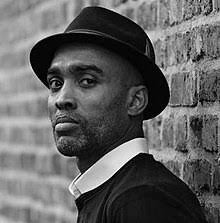
Brothers Keepers: Adriano (Letzte Warnung)// Adriano (Final warning)
Adé Bantu (given name Adegoke Odukoya) is a Nigerian-German musician born to a German mother and a Nigerian father. He lived as a young child in Lagos, Nigeria, but moved to Germany after high school and has stayed there since his childhood. (Black Central Europe)
Bantu has dedicated his life to activism through music. He invigorated the hip-hop scene in Germany in the 1990s as a founder of the band “Weep Not Child.” (Black Central Europe) After that band dissolved, he turned towards a different genre of music and started the band BANTU in 1996. BANTU is an acronym for “Brotherhood Alliance Navigating Towards Unity,” and the band played a unique combination of Afropunk, Yoruba, and other types of music. BANTU became popular in both Nigeria and Germany.
After the reunification of Germany in 1990, violence against Black Germans and immigrants increased in the two years following reunion. Racist attacks again made headlines in 2000 with the brutal murder of Alberto Adriano, a man of Mozambiquan descent who had been living in Germany for 20 years at the time of the attack. He was beaten to death by skinheads in Dassau, formerly a part of East Germany. (Donaldson)
Although there is not much specific data regarding the number of racially motivated crimes in East Germany before 1990, it is clear that there were a high amount of attacks post-reunification. This has been attributed to Germans’ new sense of national identity and an attempt to preserve it and exclude people who do not “fit” into this identity like immigrants or people of color. (Donaldson)
In response to the murder of Adriano, Adé Bantu founded a collective entitled “Brothers Keepers” made up of Afro-German musicians dedicated to eradicating the racism engrained in German society. (Black Central Europe) The group lobbied for new immigration legislation and anti-discrimination policies. They released an album Lightkultur in 2001 that included the song “Adriano,” addressing Alberto Adriano’s murder just one year earlier.
Bantu is determined to maintain his identity as both a Nigerian and a German, and to argue that the two can coexist. He continues to do groundbreaking work in the realm of Afrofunk and activism.
Bibliography:
Adé Bantu (*1971). (2021, May 11). Black Central Europe. Retrieved May 10, 2022, from https://blackcentraleurope.com/biographies/ade-bantu-olivia-blackmore/
Sonya Donaldson (2015) After the Berlin Wall: hip-hop and the politics of German reunification, African and Black Diaspora: An International Journal, 8:2, 190-201, DOI: 10.1080/17528631.2015.1027326
